
Theo Ellington
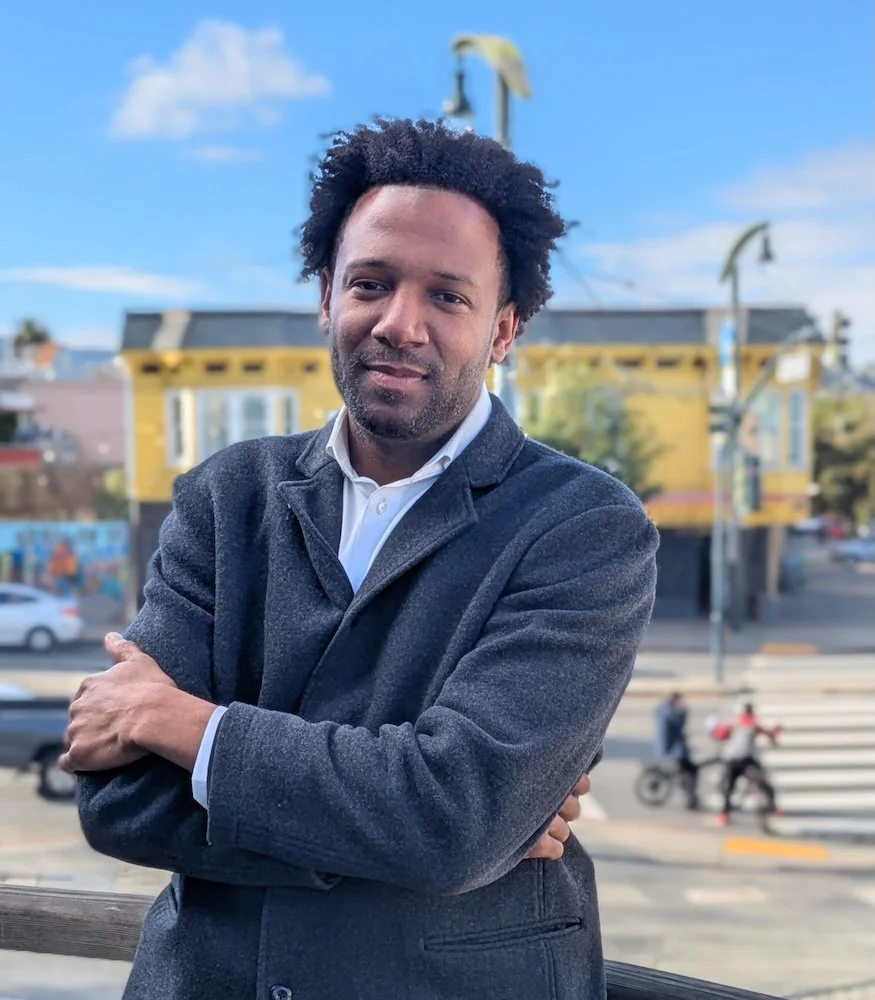
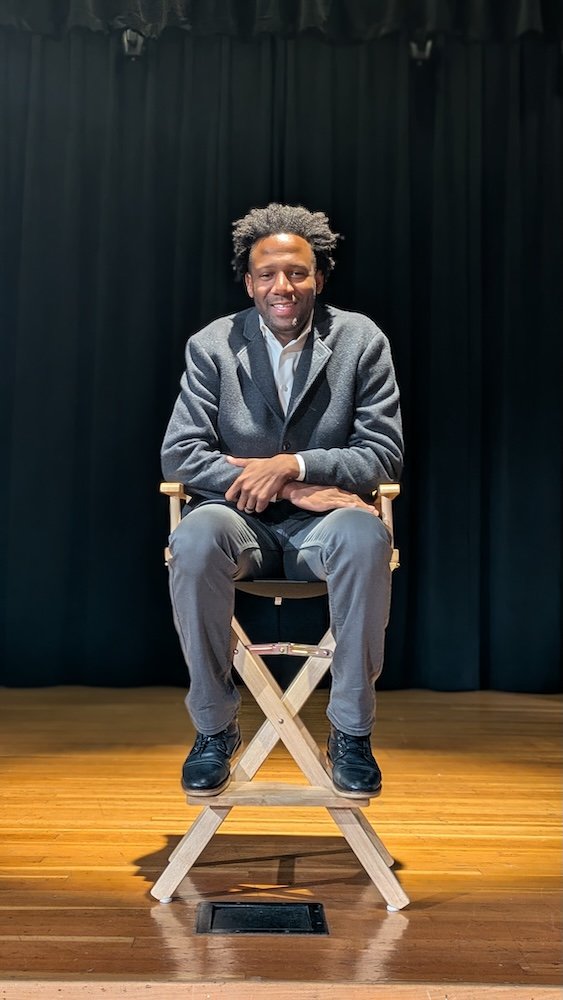
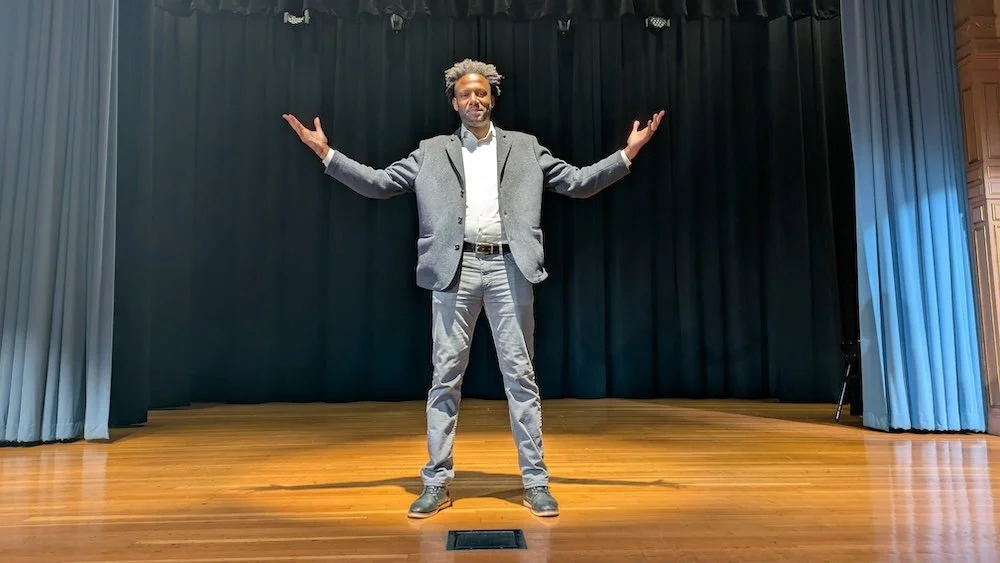
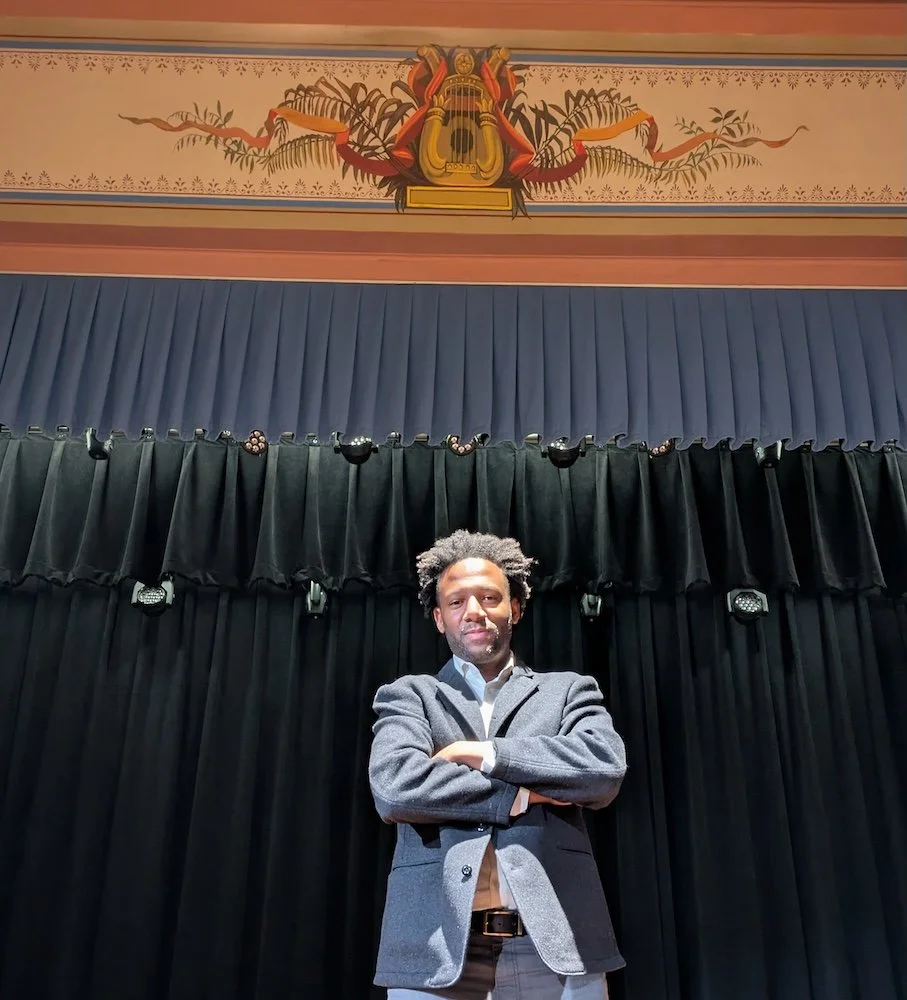
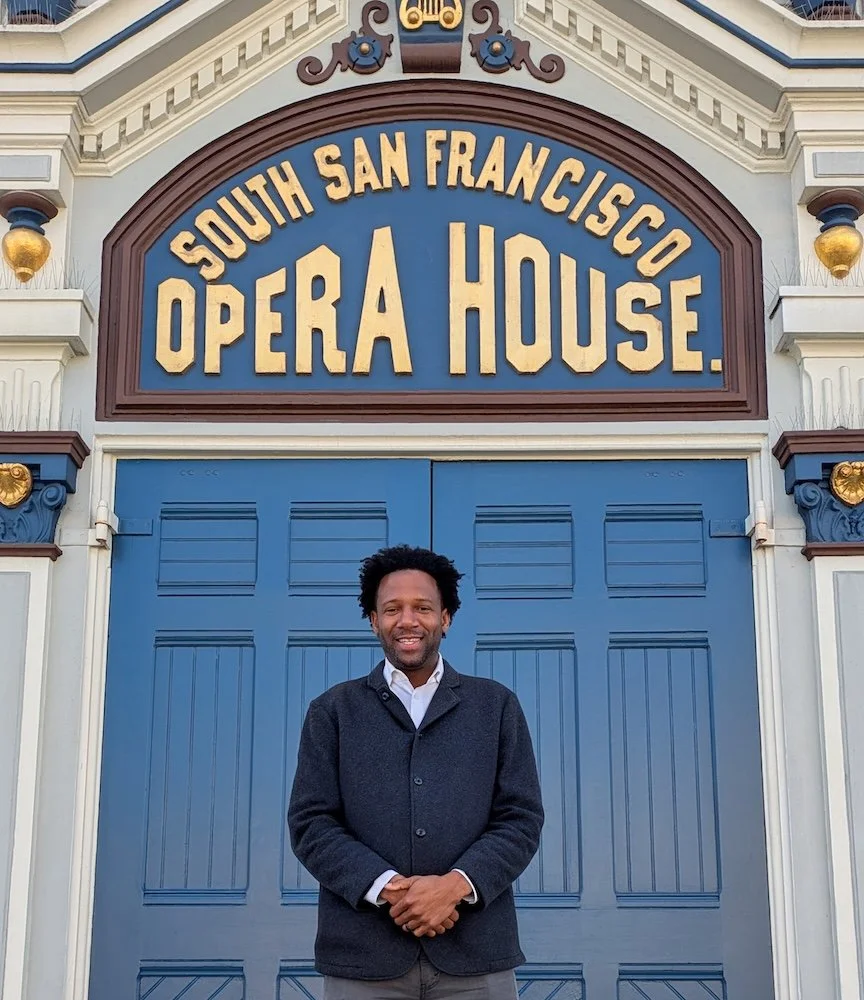
Today, Theo Ellington is the secretary at the Ruth Williams Opera House. This born-and-raised San Franciscan is also running to be the next D10 supervisor.
In Part 1 of this episode, meet Theo. His maternal grandfather, Clifton Weeks, came to SF because his sister, Marie Weeks (Theo's great-aunt), had come here. Clifton and his sister had grown up in rural Natchez, Mississippi, but they came out West during the Great Migration. Their first landing spot was The Fillmore.
Clifton found work as a laborer, where he helped build roads and bridges. He also did a little work at the shipyard back when it was still in The City. He had three daughters and made enough money to be able to buy a house in Bayview. Theo grew up in that house with his aunts and cousins.
Theo’s dad, Grant Ellington, a veteran, came here from Cleveland as an adult. While Theo isn’t 100 percent sure what the story is, his parents say that they met at a party … in the Eighties, no less. Grant was a big dude, 6'5", and he commanded a presence.
Grant would come by the house, Theo says, and seemed overly concerned with whether his son had a girlfriend. Theo would get that question as young as 6. His dad passed away when Theo was in high school.
Theo has two brothers—one older and one younger. He was the third-youngest among the 10 cousins living in his house at Third and Palou. They grew up pre-internet, and so, like a lot of us, went out and made up their own games. He and his cousins and their friends would stay out until the streetlights came on. Theo goes an aside about one of the games they invented—"baserunner." They rode bikes and skateboards, as well.
He was born in 1988 and went to a lot of school all in The Bayview. Because he’s born-and-raised, I ask Theo to rattle off the schools he attended: Charles Drew Elementary, afterschool at Leola Havard, and Gloria R. Davis Middle School, where he helped make a documentary on a grant from Salesforce about the 24-Divisadero called Bus 24 "The Diversity Bus." It’s very much worth watching:
That experience really helped to shape Theo’s perspective. He started to see his neighborhood, The Bayview, in a different light. And he saw the rest of The City. It sparked a curiosity in him—why was his own hood living in such poverty while other parts of SF thrived?
Theo was in the top of his class at Davis Middle School. He began high school at Sacred Heart, and suddenly found himself at the bottom of his class. Drawing from his experience making the Muni documentary, for his junior year, he transferred to School of the Arts (SOTA), where he could focus less on academics and more on filmmaking and documentaries.
When he was a kid, Theo had done some acting with American Conservatory Theater (ACT) and WB TV, back when they had a studio in The Bayview. He spent two years in SoCal at Marymount College. One aspect he appreciated as a young freshman was the townhouse dorms, which felt less like typical college dorms and more like adult homes. The move served two goals—go to college, but also, pursue his dream of working in the film industry.
While at Marymount, Theo worked at the local Boys and Girls Club, where he and others helped young boys who lacked role models. The experience allowed him to see how life in Southern California was different than life in his hometown.
In Part 2, we pick up where we left off in Part 1. While in college at Marymount, Theo ran the Boys and Girls Club program with Phillip Redd. He liked the connections and impact he had made in SoCal, and wondered whether he could do the same at home. This was back when Barack Obama was first running for president, and there was a prevailing sense of hope and possibility pervading life for a lot of folks.
And so Theo moved back home. He transferred to Notre Dame de Namur in Belmont after his sophomore year, and got a degree there three years later. Upon his arrival in The City and concurrent with his time in college in The Bay, he got involved in SF politics serving on commissions and boards. It helped him really dig in to living here.
Then-mayor Newsom appointed Theo to the Youth Commission. He had done yet another documentary in high school, this time on homelessness in The City. That got the mayor’s attention. "The Homeless Orchestra" compared the crisis of the unhoused population to the inner workings of an orchestra. The mayor took that doc to Davos, Switzerland, and showed it at the World Economic Forum there. Young Theo talked with folks like Tom Ammiano and Matt Gonzalez for his movie.
He lived near his transfer college, Notre Dame de Namur, in Belmont on the Peninsula. After class, he’d hurry back to San Francisco for Youth Commission meetings. He also sat on the Southeast Community Facility (SCF) Commission. Theo and I go on a sidebar here about how we use the tools at our disposal—tech, government—for better and for worse.
From his place on the SCF Commission, Theo joined the commission on community investment and infrastructure. They oversaw the development of Hunter’s Point Shipyard, Mission Bay, the Transbay Terminal, as well as a few other spots around The City. They worked on housing in those areas and approved 3,000 units, one-third of which were affordable and 250 that were set aside for formerly houseless families.
Theo, his mom, and his brother had moved to Third and Newcomb, near the opera house where we recorded. With that move, Theo saw BVOH as a community fixture. The opera house has been there since 1888 (which we learned in our episode with them). Theo took classes there when he was a kid. Around 2010, he walked in and asked how he could get involved. He joined the board and took over years later as interim executive director after a shakeup.
In his tenure as interim ED, he helped get a $250K grant for lighting and sound. They were able to give grants to artists and they launched their SF Sounds series: an artist is actually on the floor with eventgoers for those events.
I ask Theo about friend of this show Allegra Madsen and her time at BVOH. After stating the obvious, that Allegra is awesome, Theo says that the opera house wants to bring back Frameline and other film fests. “You shouldn’t have to leave your neighborhood to catch a film,” he says.
We also talk about the Hey, Auntie! gumbo contest, which I helped judge, back in 2025 and which took place at the Bayview Opera house.
Then we talk about Theo’s run for D10 supervisor. The campaign’s premise: We can do better in the Southeast. He ran back in 2018, but he’s running again because of the potential he sees for the area to dictate the kind of community it wants to become. San Francisco obviously has equitable differences among different parts of our city. Theo cites better transit, housing, and support for small businesses among the most important issues he wants to tackle.
Visit his website for more info: https://www.theoellington.com/.
We recorded this podcast at the Bayview Opera House in Bayview in November 2025.
Photography by Jeff Hunt
